Materials, study spaces & everyday carry
Libeco Linen: A Material Guide for Study Spaces and Everyday Carry
A well-used bag has a quiet job: keeping the tools of a busy day together, accessible and ready to go. Linen brings a particular character to that task—breathable, textured and shaped by use. Understanding the fabric, its construction and its care can help students and commuters decide when a linen accessory belongs in the rotation, and how to make it last.
Published October 21, 2026
A useful fabric, not a magic one
Linen is made from flax fibers. In everyday language, the word can evoke a cool shirt, a crisp tablecloth or a relaxed summer layer. In an accessory, it means something more practical: a woven surface with a distinctive hand, a natural appearance and performance shaped as much by the yarn and construction as by the fiber itself.
For someone moving between a classroom, library, studio or workplace, the appeal is easy to understand. A linen pouch can gather small essentials without the polished sameness of synthetic fabric. Its surface has visible texture, and its appearance can change with handling. But linen is not automatically indestructible, stain-proof or suitable for every kind of load. A fabric’s name is only the beginning of the buying decision.
That distinction matters when choosing accessories for student organization. A bag that holds pens, a charger and a few personal items has a different brief from one expected to carry textbooks, a laptop and a water bottle all day. Fiber, weave, lining, seams, closure and dimensions each affect what a piece can do. The most helpful question is not simply “Is it linen?” but “Is this linen item made for the way I plan to use it?”
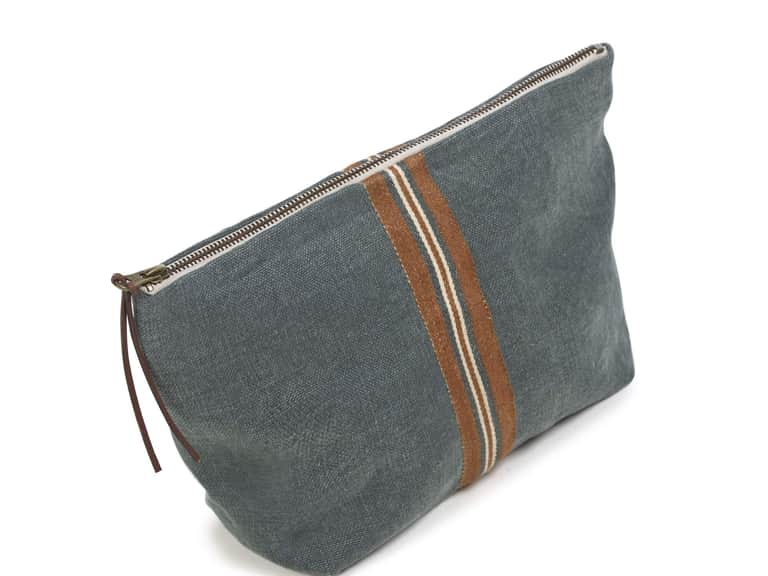
Libeco offers a brand-specific example of how those details can come together. Its Atlas Cosmetic bag is described as 100% linen, with a stonewashed finish, a River color, pure linen trim and a striped lining. The listed fabric weight is 15 oz/yd², or 520 g/m². Those specifications help explain the character of this particular accessory; they should not be taken as a universal description of all linen bags.
What linen brings to a daily routine
Breathability is one of linen’s familiar advantages. The structure of woven cloth allows air to move through it, although the result depends on the weave, thickness and any backing or lining. For an organizer carried inside a larger school bag, air circulation may be a pleasant feature, but it is not a substitute for a moisture-resistant lining when a spill or damp environment is a concern.
Linen also has a tactile presence. The surface is not perfectly smooth, and that irregularity is part of its appeal. A stonewashed finish, such as the one specified for the Atlas Cosmetic bag, gives fabric a softer, more relaxed appearance than a sharply pressed surface. It can make an accessory feel at home on a desk as well as in a travel bag, without requiring it to look pristine at all times.
Natural texture can be useful in organization, too. When several small pouches look alike, a pronounced fabric or color can make one easier to spot. That is a modest benefit, not a substitute for a thoughtful system. Students can still label pouches, keep frequently used tools in consistent places and avoid turning a compact organizer into a miscellaneous drawer with a zipper.
In a study setting, linen accessories are best understood as containers for smaller items: charging cables, sticky notes, earbuds, stationery or personal-care essentials. A pouch can reduce loose objects rattling around a backpack and make a transition from class to library more orderly. For textbooks, a heavy device or bulky binders, choose a bag designed and constructed for that load rather than expecting a cosmetic pouch to serve as a general-purpose school bag.
Material choice is only one part of comfort. A student carrying a full day’s supplies should consider total weight, how the load sits against the body, and how often it must be lifted or moved. A linen accessory might make the contents of a larger bag easier to manage, but it will not correct an overloaded backpack or an awkward carrying setup.
Read the construction, not just the label
Product descriptions are most useful when they provide concrete details. Fiber content tells you what the fabric is made from; weight offers a clue to its substance; lining and closure describe how the item is organized and protected. Measurements, where available, help answer the question that matters most in practice: will the things you need actually fit?
The Atlas Cosmetic bag is listed as 100% linen, with a River-and-Natural striped lining and linen trim. A lined interior may give contents a finished, contained space, while the stripe can make the inside easier to distinguish from the exterior. Yet a lining does not automatically mean waterproof protection. If carrying a pen that could leak, cosmetics, or anything that might spill, check the care and construction details and consider using a separate sealed container.
The stated weight of 15 oz/yd² (520 g/m²) suggests a substantial textile compared with very lightweight linen. It is a useful point of comparison, not a guarantee of durability on its own. A sturdy fabric can still be affected by seam quality, stress at corners, abrasion and how heavily the accessory is packed. If dimensions and closure details are important to your intended use, verify those specifications before relying on the item for a particular set of supplies.
For a compact study kit, make a quick inventory before choosing a pouch. Gather the items you actually use, including any cable or small notebook, and estimate how much space they take up together. Leave room to close the bag without forcing the zipper or straining seams. An organizer that is slightly too small can become frustrating; one that is far too large can collect items simply because there is room.
It is also worth asking whether a soft accessory needs structure. A pouch that holds small, non-fragile objects may work well with a flexible silhouette. A device, glasses or other delicate item may need more padding and a dedicated protective compartment. Linen can be part of a thoughtful design, but it does not provide impact protection simply by being a natural fiber.
A Libeco example for desk and bag
The Libeco Atlas Cosmetic bag illustrates how linen can move between personal care, travel and desk organization. Its River color, stonewashed 100% linen exterior, linen trim and striped lining give it a clear material identity. The product description frames it as suitable for travel, vanity or desk storage—uses that overlap neatly with the small essentials a student or commuter might want to keep in one place.
That does not make it a dedicated school bag, nor does the product information establish that it will suit every schedule. Its most natural role is as a smaller organizer inside a larger carryall: a place for compact items that otherwise drift between pockets. Before using it for a daily study kit, check its dimensions and confirm that the contents can be carried without overfilling it. A well-matched accessory is useful because it fits a routine, not because a label promises to solve one.
There is a broader point here about brand-specific material guidance. Linen products are not interchangeable. A tightly woven, lined pouch behaves differently from a loosely woven unlined tote. Finishes can change the look and feel; construction can change how a seam responds to repeated handling. Libeco’s listed materials offer a starting point for evaluating this particular item, while the care label and current product specifications remain the best guide for its maintenance.
For students trying to build an organized setup, a small pouch can support a simple rule: keep frequently used essentials together and return them to the same place after class. That habit matters more than the fabric. The fabric’s role is to provide a suitable, pleasant container—one that feels good to use and fits the contents without unnecessary bulk.
Linen care: small habits, lasting difference
Care begins with the label. Linen articles may differ in finish, lining, trim and construction, and those details can affect the safest cleaning method. Do not assume that every linen accessory can be washed in the same way, or that a product described as natural is automatically suited to machine washing. If instructions are not available, ask the maker or retailer rather than experimenting on a finished item.
For routine upkeep, start with the least aggressive option. Empty the bag, shake out crumbs and dust, and spot-clean a small mark only if the care instructions allow it. Use a clean, lightly damp cloth and test an inconspicuous area first. Avoid vigorous scrubbing, which can distort the surface or change the appearance of a finish. If the accessory has a lining or trim made from a different material, treat the item as a combination of components rather than as a single sheet of linen.
When washing is approved, follow the stated temperature, cycle and drying directions. Heat and rough handling can encourage shrinkage, creasing or changes in shape, depending on the fabric and construction. Reshape the item gently while it is damp, if the label permits, and let it dry thoroughly before storing it. A damp pouch shut inside a backpack can hold moisture where air cannot circulate.
Linen’s character can evolve with use. Depending on the weave and finish, handling may soften the fabric and create a more relaxed look. Creases are part of the material’s behavior, not necessarily evidence of damage. At the same time, persistent abrasion, overloading or repeated contact with rough surfaces can wear any textile. A bag carried beside keys, buckles or hard-edged equipment may need more frequent inspection than one kept in a clean desk drawer.
Store linen accessories clean and fully dry. Avoid leaving them compressed beneath heavy objects for long periods, especially if maintaining their shape matters. If the item is used for toiletries or other personal-care products, wipe away residue promptly and keep anything likely to leak in a separate, sealed container. These ordinary precautions protect both the accessory and the rest of a student’s supplies.
Build an everyday-carry system that works
Good organization is less about owning more compartments than knowing where things belong. Begin with the day’s essentials: course materials, a device if needed, writing tools, keys, transit card, water and personal items. Separate what must be protected from what simply needs to be easy to reach. Then decide whether a compact pouch adds order or just another layer to search through.
A practical system can have three zones. Keep high-use items in an accessible pocket, class-specific materials together, and small loose essentials in a pouch. The pouch can be a linen accessory when its size, closure and care requirements suit the contents. Heavy items should sit close to the back in a backpack designed for them; fragile devices belong in a protective compartment. Small organizers should not take the place of appropriate support for larger loads.
Before leaving home, use a short reset: check the schedule, pack only the materials needed, confirm that electronic devices and chargers are present, and remove items that no longer belong in the bag. At the end of the day, return essentials to their designated places and discard scraps or wrappers. A repeatable routine reduces the number of last-minute searches and helps prevent an organizer from becoming a catch-all.
Careful packing can also make a bag easier to maintain. Keep pens capped, separate damp objects, and avoid placing sharp tools directly against fabric. If a pouch is meant for stationery, a small sleeve can protect the lining from ink or graphite. If it is used for travel toiletries, contain liquids independently. The goal is not to make a textile accessory perform every job, but to use it in a way that respects its design.
A quick checklist before choosing linen
- Match the purpose. Decide whether the item is for stationery, cables, personal care or another specific set of essentials.
- Check dimensions. Compare the listed size with the objects you plan to carry, leaving enough room to close the accessory comfortably.
- Look for construction details. Review the fiber content, fabric weight, lining, trim, closure and any protective features.
- Set realistic expectations. Linen has a recognizable texture and may crease or soften; it is not automatically stain-proof, waterproof or padded.
- Read the care instructions. Use the maker’s guidance, especially for lined or finished pieces, and test spot-cleaning in an inconspicuous area.
- Plan for the full load. Keep heavy books and electronics in appropriate bags or compartments, and avoid asking a small pouch to carry more than it was made for.
- Build a repeatable routine. Give essentials a consistent home and reset the bag at the end of the day.
The real measure is usefulness
In a crowded school or workday, small systems can make movement feel less chaotic. A well-chosen accessory gives loose essentials a place, and a breathable, textured fabric can make that everyday object feel considered rather than disposable. Linen’s appeal lies in its combination of material character and practical potential—but the result depends on the specific weave, finish and construction.
Libeco’s Atlas Cosmetic bag offers a precise case study: stonewashed linen, linen trim, a striped lining and a substantial stated fabric weight, in a format intended for compact organization. Those details make it relevant to desk storage and everyday carry when its size and purpose align with the user’s needs. It is one example, not a template for every linen accessory.
For students, the best choice is the one that fits the real contents of the day, can be cared for without guesswork and supports habits that reduce clutter. Linen can be part of that choice. The lasting value comes from matching the material to the task—and returning each essential to its place, day after day.